Built to Last
Generations.
Tile roofs are built to last decades when installed correctly. The beauty of tile means nothing without the protection underneath — and we install both with the same level of care.
UNDERSTANDING THE TILE ROOF SYSTEM
A tile roof is more than the visible tile itself. The performance, longevity, and protection of the system depends on the layers underneath — from underlayment and battens to ventilation and waterproofing.
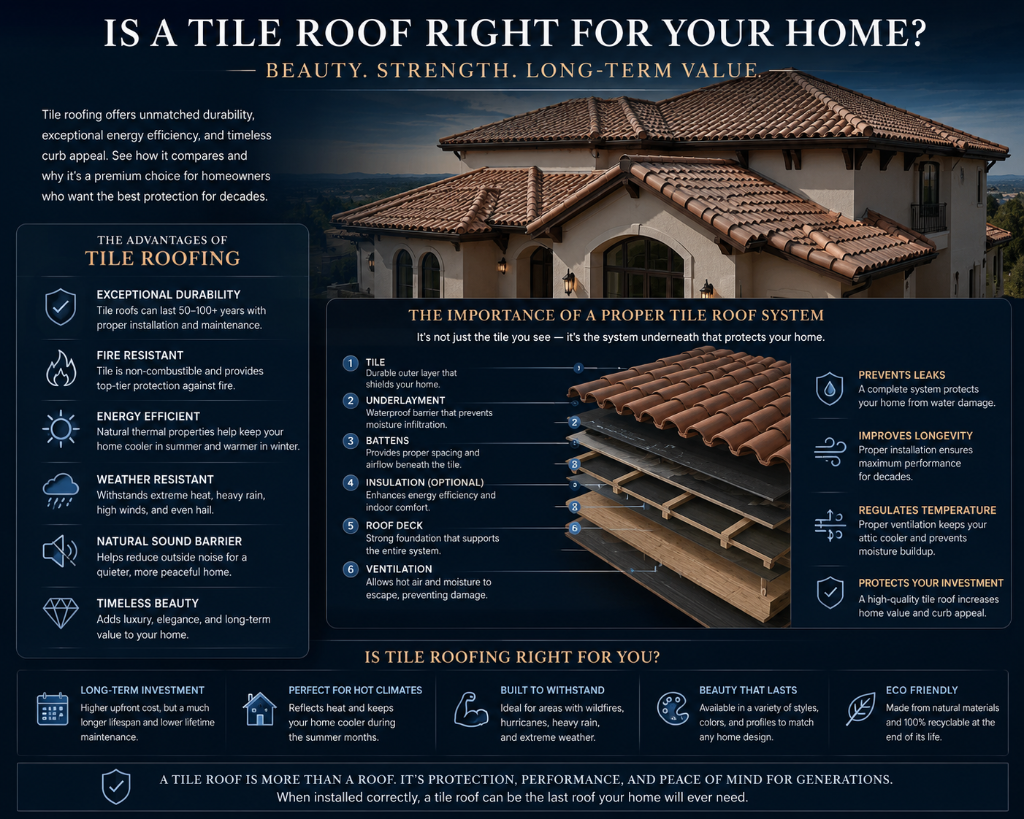
WHAT MAKES A TILE ROOF
PERFORM FOR DECADES?
Tile roofing is one of the most rewarding investments a homeowner can make — when every layer beneath the tile is given the same attention as the tile itself.
Tile Routes Water. Underlayment Stops It.
Many homeowners believe tile is waterproof. It isn't. Tile sheds water — the underlayment beneath it is the true moisture barrier. This is why the quality of the underlayment system is the single most important factor in a tile roof's long-term performance.
"The beauty of tile means nothing without the protection underneath."
Assumes certified installation & proper maintenance
"Tile roofs are built to last decades when installed correctly. The beauty of tile means nothing without the protection underneath."
Structural Assessment
Load & Framing EvaluationTile is significantly heavier than asphalt shingles — concrete tile weighs 9–12 lbs per sq ft, clay up to 15 lbs. Before installation, the roof framing must be evaluated to confirm it can support the added load without deflection.
Installing tile on an undersized structure causes rafter sag, ridge stress, and potential failure over time.
High-Performance Underlayment
The True Waterproof LayerTile itself does not waterproof a roof — the underlayment does. A premium two-ply or self-adhering underlayment system beneath the tile is the critical moisture barrier that protects the home. Tile routes water; underlayment stops it.
Cheap underlayment beneath expensive tile is the most common cause of tile roof failure within 15 years.
Battens & Counterflashing
Ventilation & AttachmentHorizontal wood battens create the airspace beneath tile that allows ventilation and prevents moisture trapping. Counterflashing at walls, chimneys, and penetrations must be precisely integrated — it's a complex detail that separates quality installs from shortcuts.
Improperly flashed tile penetrations are one of the top sources of expensive interior water damage on otherwise beautiful homes.
Tile Selection & Layout
Profile, Weight & CoverageTile comes in concrete, clay, and composite profiles — each with different weight, absorption rates, and thermal performance. The layout pattern affects both aesthetics and drainage behavior. Proper overlap and stagger ensure water sheds cleanly.
Incorrect tile overlap or improper layout creates wind uplift vulnerabilities and channeling that directs water under the tile field.
Ridge & Hip Caps
Peak Sealing & FinishRidge and hip caps seal the highest points of the roof where two planes meet. These are set in mortar or mechanically fastened depending on the profile, and represent a critical finishing detail that also handles the highest wind exposure on the roof.
Loose or improperly set ridge caps are the most common cause of wind-driven rain infiltration on tile roofs.
Maintenance & Inspection
Long-Term PerformanceTile roofs are low-maintenance but not no-maintenance. Cracked or broken tiles should be replaced promptly before water bypasses them to the underlayment. Walking on tile incorrectly causes hairline fractures that aren't visible until they allow leaks.
A $150 broken tile replacement, ignored for two seasons, can result in $5,000+ of interior ceiling and decking repair.
TILE ROOF CARE GUIDE
A tile roof properly maintained will outlast the mortgage on your home. Here's how to protect the investment.
READY FOR A ROOF THAT
LASTS A LIFETIME?
We'll walk you through the right tile profile, underlayment system, and installation approach for your home — clearly and without pressure.