Water Goes Where
You Tell It To.
Most homeowners don't realize how much damage poor drainage can cause. A properly functioning gutter system protects more than just the roof — it protects the entire home.
EVERY COMPONENT
HAS A PURPOSE
A gutter system is an engineered drainage solution. When one part is undersized, misaligned, or degraded, the entire system fails — and the consequences reach far beyond the roofline.
Where Does Your Water Go?
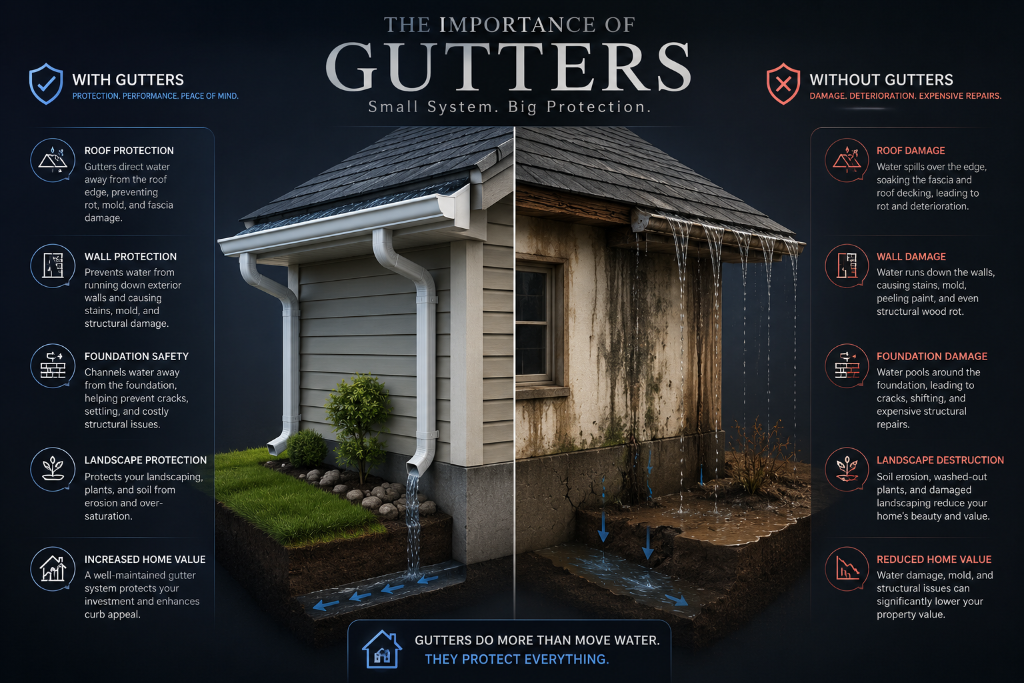
During a typical Central Valley rainstorm, hundreds of gallons of water fall on your roof. A properly designed gutter system routes every drop safely away from your home. Without it, that water goes exactly where it causes damage.
"A properly functioning gutter system protects more than just the roof — it protects the entire home."
Seamless Gutters
Custom-Fabricated On-SiteUnlike sectional gutters that come in pre-cut lengths joined by seams, seamless gutters are formed on-site to the exact length of each run. This eliminates the most common failure point — the seam joints where leaks develop over time.
Sectional gutters fail at joints within a few years. Seamless systems last decades with minimal maintenance.
Proper Slope & Pitch
Drainage EngineeringGutters must be installed at a precise pitch — typically ¼ inch drop per 10 linear feet — to ensure water flows efficiently toward downspouts rather than pooling. Improper slope is the leading cause of standing water and overflow.
Standing water in gutters breeds mosquitoes, accelerates corrosion, and adds excess weight that pulls hangers loose.
Downspout Placement
Water Routing & DischargeDownspouts must be correctly sized for the roof area they drain and positioned to discharge water well away from the foundation. Extensions and splash blocks direct flow away from the home's footprint.
Water pooling near the foundation is a primary cause of basement flooding, soil erosion, and long-term structural movement.
Fascia Board Protection
Roofline IntegrityThe fascia boards that gutters attach to are especially vulnerable to moisture. Properly hung gutters with drip edge integration prevent water from running behind the gutter system and saturating the fascia wood.
Rotted fascia boards require expensive carpentry repair and often indicate moisture has already entered the roof framing.
Overflow Prevention
Capacity & MaintenanceGutters sized inadequately for the roof area, or clogged with debris, overflow during heavy rain — directing concentrated water exactly where you don't want it: against siding, into window frames, and down foundation walls.
A single overflow event during a heavy rain can deposit hundreds of gallons of water against the foundation.
Gutter Guards & Maintenance
Long-Term PerformanceLeaf guards and debris screens reduce the frequency of cleaning and prevent blockages from forming. Even with guards, annual inspection ensures brackets are tight, seals are intact, and flow remains unobstructed.
Gutters that go unmaintained for 2–3 years typically require full replacement — not just cleaning.
WHY PROPER DRAINAGE MATTERS
Most gutter problems start small and invisible. Over time, poor drainage can damage fascia, siding, landscaping, foundations, and even interior structures. A properly installed gutter system quietly protects your home every single day.
Protects Foundation
Channels water away from soil and footings, preventing settling, cracking, and costly structural movement.
Prevents Roof Rot
Proper edge drainage stops water from backing up under shingles and saturating fascia and decking.
Controls Water Flow
Engineered slope and sizing route every gallon safely away from siding, windows, and landscaping.
GUTTER MAINTENANCE GUIDE
Gutters require minimal upkeep when installed correctly — but that upkeep matters.
READY FOR A GUTTER
SYSTEM THAT WORKS?
We'll assess your current drainage, identify problem areas, and give you a clear solution — no pressure, no guesswork.